January, 1965
SUBJECT: PROPELLERING THE 90 HP MOTOR FOR PEAK SKIING PERFORMANCE.
To obtain peak performance for water skiing, it is very necessary to use propellers which allow the engine to develop sufficient thrust in the first few seconds of acceleration and to have a well-tuned and properly-adjusted engine. During this period, a skier may exert from 50 to 400 pounds of pull on the tow line and boat. This effort is multiplied by the number of skiers being pulled and varies with their skiing ability, type of skis, skier weight, rate of throttle opening and thrust available.
Engineering tests with both live and mechanical water skiers reveal that the pull on a skier's arms diminishes rapidly after his skis reach the surface of the water and that, generally speaking, a skier is planing at 7 mph. Since only the strongest skier can endure these high rates of pull more than momentarily before losing his grip on the tow bar, it is necessary to have the outboard develop the required thrust to plane both the skiers and boat almost instantaneously. This is best accomplished by use of a propeller designed specifically for this type of water sport. In most skiing applications, the OMC 10 X 9-1/4 propeller (P/N 379260) will do an excellent job. The use of this propeller on some boats may mean the engine rpm will exceed the recommended 5000 maximum. This is not harmful to the engine if the following two simple rules are followed: 1) maximum rpm's should not exceed 5500, and 2) the throttle should be retarded to 5000 rpm when the boat is being operated without skiers. If no tachometer is available, retard throttle to 33 mph. Intermittent operations above 5000 rpm or 33 mph is not harmful.
The composite chart (Page 2) shows the following:
Line (1) on the chart shows thrust required to plane an average 17' boat plus 2 passengers.
Line (2) shows the thrust required to plane an average 17' boat and 2 passengers and 3 slalom skiers.
Line (3) shows TOTAL thrust available from the 90 HP Johnson outboard motor and the 10 X 9-1/4 propeller.
Line (4) shows total thrust available from the Mercury 1000 using the 19" pitch three-blade bronze propeller.
- over -
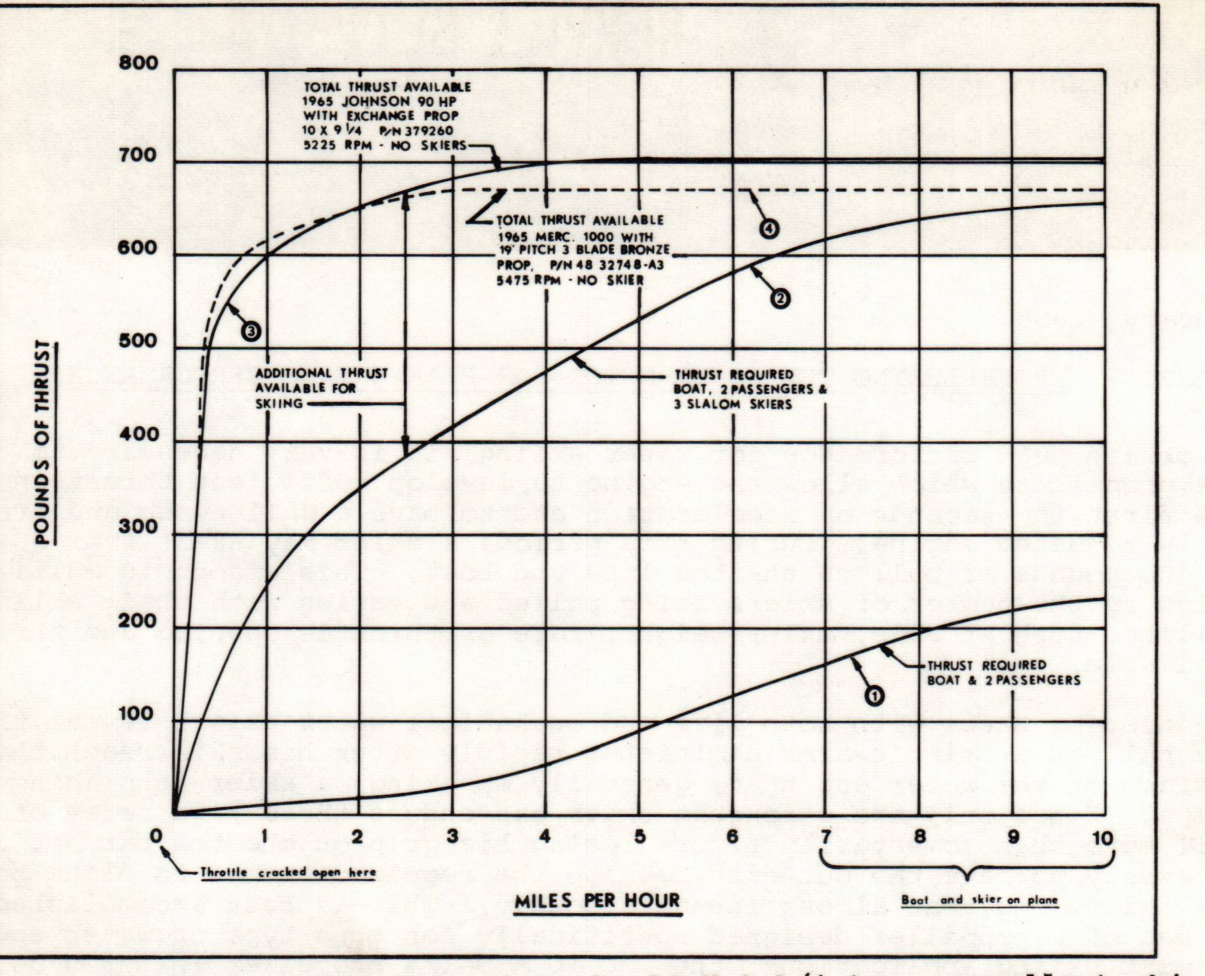
The composite chart above shows that the 10 X 9-1/4 is an excellent ski propeller and generally will pull three slalom skiers from a deep water start. It may be necessary to reduce the pitch further on heavily loaded boats. (consult accessory propeller charts).
For best engine performance and durability, it is highly recommended that boats be equipped with a good tachometer or speedometer so the boat operator can control the engine rpm and speed under all conditions. Continuous operation above the recommended speed range should be avoided.
Generally speaking, propellers that are best for skiing applications, deliver high thrust and produce good acceleration or lugging power; those with more pitch produce greater top speed and less acceleration or lugging power. The extremes in these cases are the tug boat and the racing boat.
JOHNSON MOTORS
Jack Penland
Service Promotion Manager
JP/11
NOTE: Post on your V4M - 90 HP index under heading "MISCELLANEOUS".