PEP-3 - Fine Tuning Tips for High Performance Boats

Johnson's factory guide to high-performance boat setup, troubleshooting poor speed and planing, controlling porpoising and fishtailing, selecting engine mounts, and modifying V4 SST propellers. The original four-page yellow-paper publication is reproduced below.

Johnson Performance Efficiency Pointers factory letterhead

SUBJECT:   FINE TUNING TIPS FOR HIGH PERFORMANCE BOATS

ON MODELS:   ALL PERFORMANCE APPLICATIONS

In order to achieve the maximum performance from today's high performance boats, you must be getting all of the power your motor will develop. You must use the correct mounts, steering and propeller for your rig. You must also carefully test and adjust your boat's balance, the motor position, and your propeller selection. This “Fine Tuning” will produce all of the performance your rig is capable of delivering.

The problem chart will assist you in solving performance problems. The chart does not attempt to cover boat defects or problems related to boat design.

Variations in hull weight and amount of gear you carry can affect performance.

Nose heavy boats will not “fly” properly and top speed will be lower than balanced boats.

Warped or distorted bottoms, particularly in the planing area or “pad” will affect top speed, ability to plane, “fishtailing” and porpoising.

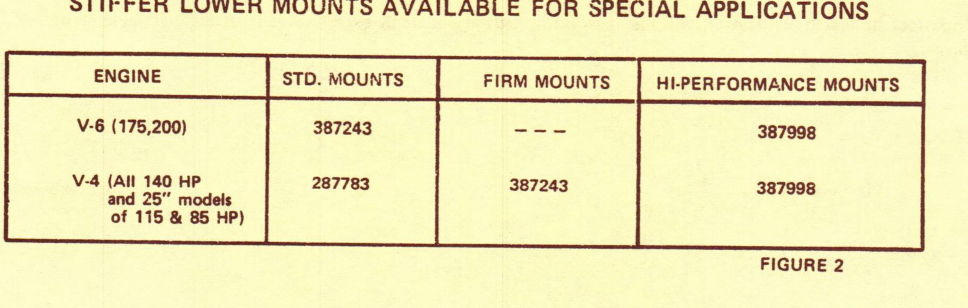
Porpoising or fishtailing can result in loss of control at high speeds. Stability will vary with different Boat-Propeller-Motor combinations. If your boat has a tendency to be unstable (“Fishtail”) at high speed or in turns, it may require optional motor mounts and/or twin cable steering. See chart, Figure 2, for optional mounts.
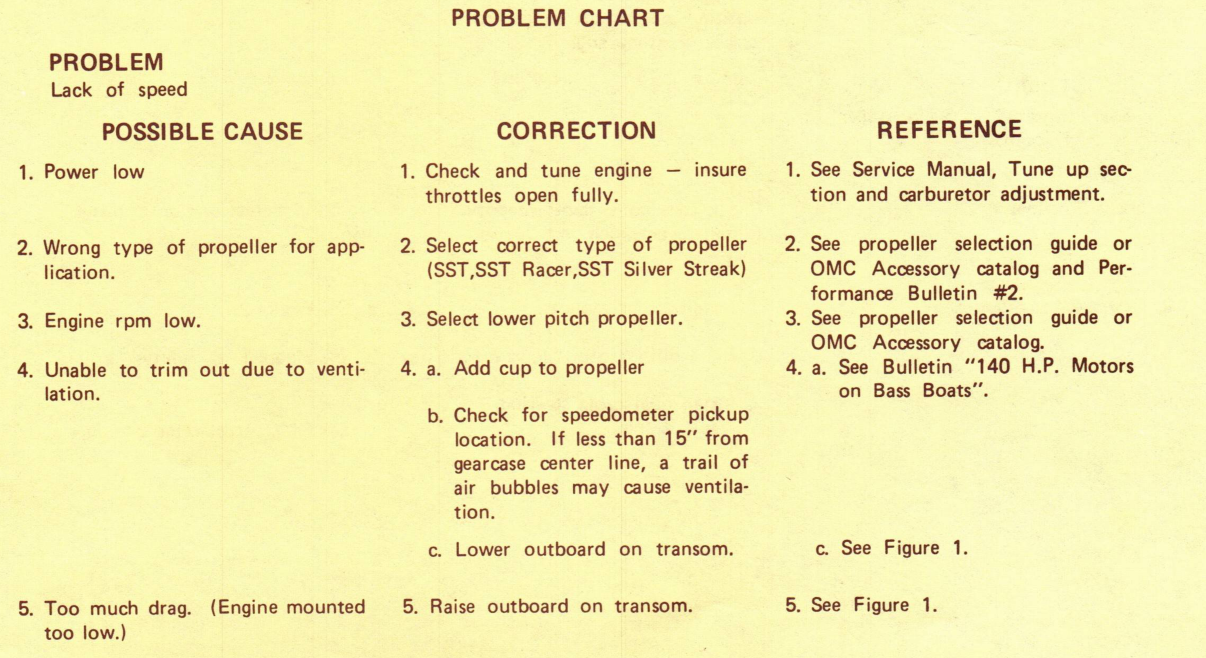
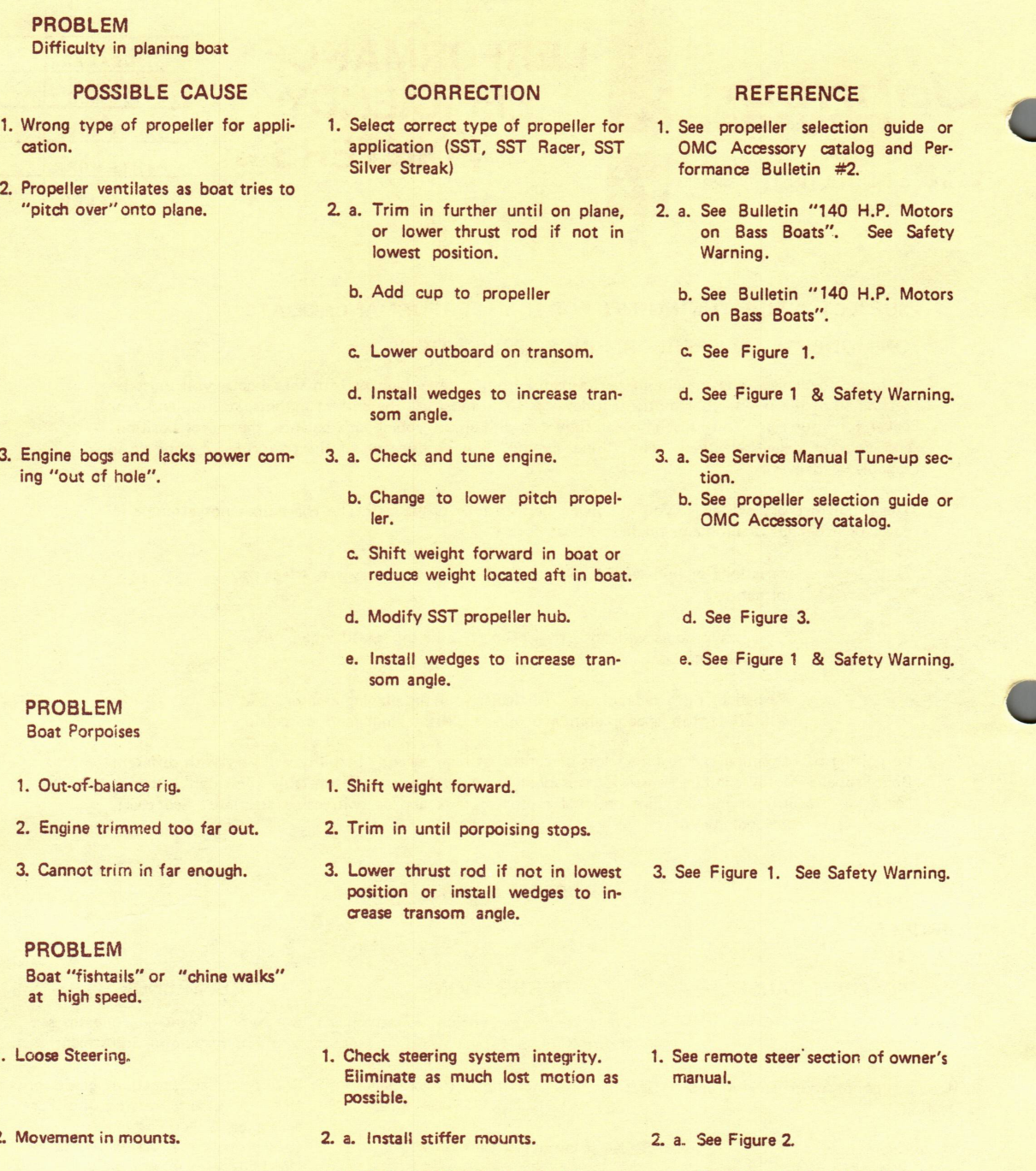
PROBLEM CHART

Original problem chart: lack of speed, possible causes, corrections, and references
Factory troubleshooting chart for planing, porpoising, and fishtailing

Safety warning triangleSAFETY WARNING

Boats must be water tested to determine proper location of angle adjusting rod. The rod limits downward trim of engine, so final setting will be lowest desired trim angle. For majority of boat/motor combinations, rod should be in innermost hole as installed by factory. For some installations, however, this may lower bow too much and produce unstable handling by causing boat to plow through water. Under no circumstances should motor be operated without angle adjusting rod installed. For adjustment see minimum trim angle position in owner manual.

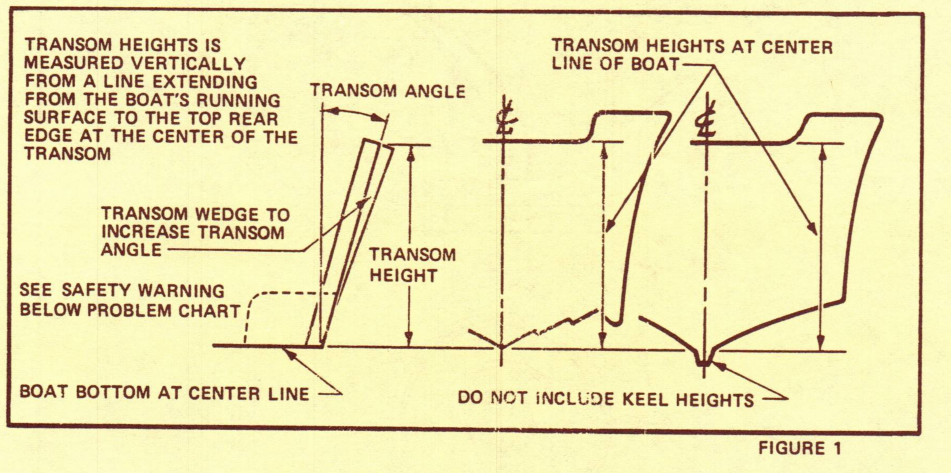
Figure 1: transom heights, wedge angle and center line of boat

Figure 1 shows how to measure transom angle and transom heights. Where the boat transom angle is 13° or less, the use of wedges will correct problems as indicated in the chart. See Safety Warning above.

High performance boats normally are built with transom heights greater than the standard 20”. Where transom heights exceed approximately 22”, excessive ventilation may occur when going on plane or when trimming out for maximum speed.

STIFFER LOWER MOUNTS AVAILABLE FOR SPECIAL APPLICATIONS

Figure 2: factory lower mount part-number table for V6 and V4 engines
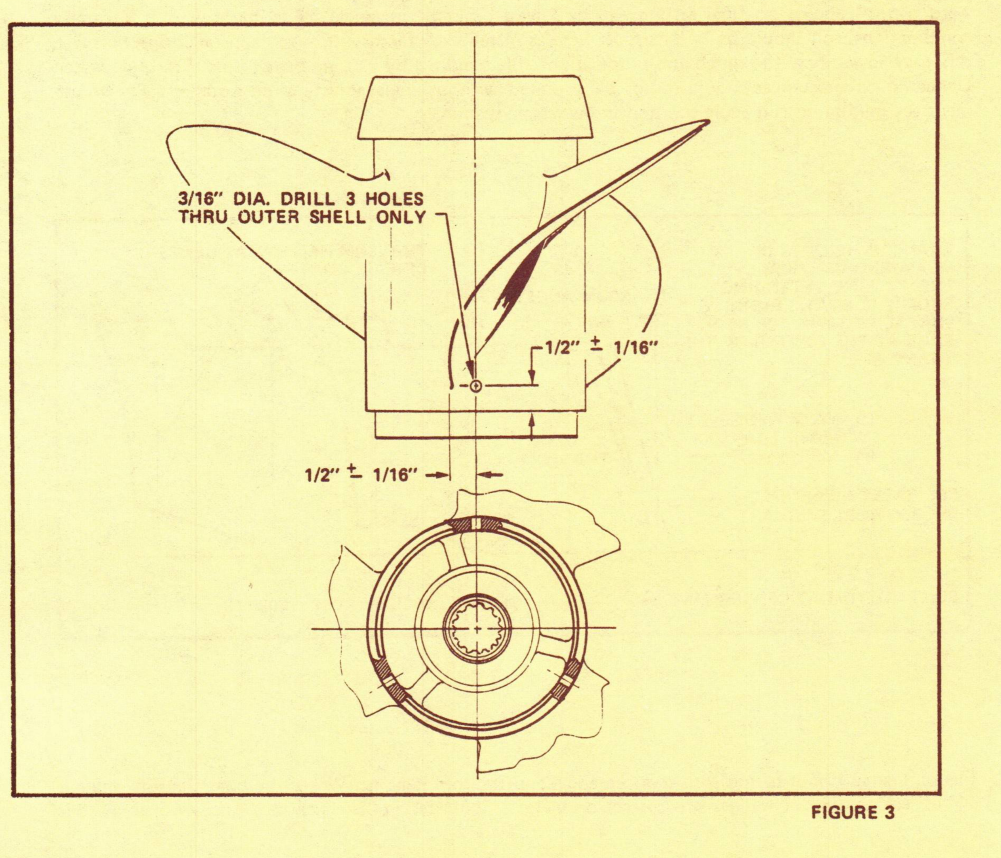
Figure 3: V4 SST propeller hub drilling diagram

V-4 PROPELLER MODIFICATION

Figure 3 shows a V-4 SST propeller modification that will improve the acceleration onto plane of V-4 motors on high performance bass boats. The holes bleed exhaust gas causing controlled ventilation during acceleration. The motor will turn higher R.P.M. and have more power to plane the boat quickly. Properly drilled, the holes will have no effect on top speed, maximum R.P.M. or ventilation in turns on a V-4 Engine.

Incorrect hole size or location will result in no improvement or in excessive ventilation, particularly in turns.

Historical references

This publication refers to Performance Efficiency Pointers #2, the OMC propeller selection guide, factory service manuals, the OMC accessories catalog, and the factory bulletin “140 H.P. Motors on Bass Boats.” Related publication links can be added when their destinations are verified.

1970-1980 Johnson Service Bulletin Index