Johnson Service Bulletin SB-1519 - OMC Gel-Seal, Cylinder Block to Crankcase Sealing

Issued March 1980, this factory bulletin explains the transition from neoprene crankcase seals to OMC Gel-Seal, including surface preparation, application amounts, and curing precautions.

Johnson Service Bulletin letterhead
SB-1519

March, 1980

SUBJECT: OMC GEL-SEAL, CYLINDER BLOCK TO CRANKCASE SEALING

Most present (and all future) service cylinder and crankcase assemblies no longer contain grooves on mating surface for neoprene "spaghetti" seals. This sealing method has been replaced by the use of OMC Gel-Seal (P/N 322702). See Figure 1. Gel-Seal seals the crankcase to cylinder block better than "spaghetti" seal and OMC Adhesive M.

NOTE

On motors that use neoprene "spaghetti" seal. Do not use OMC Gel-Seal in place of OMC Adhesive M.

OMC Gel-Seal is currently being used in production to seal the crankcase to cylinder block assemblies on all 2 thru 6 cylinder outboards.

OMC Gel-Seal is an anaerobic sealant (hardens between mating surfaces in the absence of air). Gel-Seal is easy to use and very little is needed to seal close fitting mating surfaces. One 50 ml tube of Gel-Seal will seal at least 50 motors if used as recommended. Gel-Seal has a shelf life of at least one year if stored out of direct sunlight. If Gel-Seal hardens in nozzle, hard material may be removed and rest of tube used. Do not use similar appearing jel-type sealants, since some contain fillers that have a shimming effect. This can cause improper bearing location, bearing misalignment, and tight armature plate bearings.

USING OMC GEL-SEAL:

1. Surface preparation: Remove all traces of old Gel-Seal by using OMC Gel Seal and Gasket Remover (P/N 390928). See Figure 2. In using Gel Seal and Gasket Remover, spray the area to be cleaned and let stand for 5-10 minutes before cleaning off the remover.

NOTE

Care should be taken to prevent over-spray of Gel Seal and Gasket Remover on painted surfaces as the paint may be removed. Wear eye protection and rubber gloves or other non-porous hand protection while working with Gel Seal and Gasket Remover.
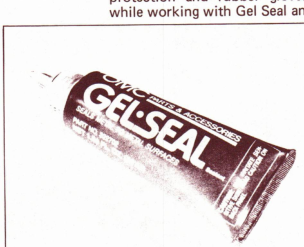
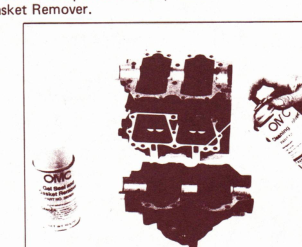
Figure 1: OMC Gel-Seal tubeFigure 2: Gel Seal and Gasket Remover application
CR 79-60   Rev. 1

Use OMC Cleaning Solvent (P/N 390905) to remove all traces of Gel Seal and Gasket Remover. See Figure 2. Use a black light to check for any remaining Gel-Seal. The black light should be used in a darkened room. Hold it at an angle to the piece being inspected. A small amount of OMC Needle Bearing Grease (P/N 378642) should be applied to the crankcase and cylinder block labyrinth seals before assembly to prevent motor "lock-up" from excess Gel-Seal. Assemble pistons, rods, crankshaft and bearings using techniques outlined in the Service Manual. Again use Cleaning Solvent to remove any oil or grease on flanges from assembly. Oil or grease on flanges will cause leaks.

NOTE

Be sure your hands are clean and free of oil or grease before applying Gel-Seal.

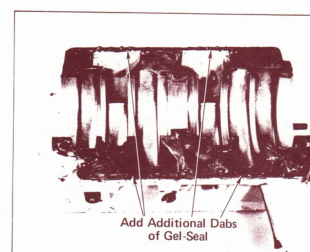
2. Applying Gel-Seal: Squeeze out a ball [3/16" (5mm) on 4-35 HP models, 1/4" (6mm) on 50-60 HP models and 3/8" (10mm) on 70 HP - V-6 models] of Gel-Seal and dab it along one flange of the crankcase. Pat-a-cake the Gel-Seal over one crankcase flange from end to end, being sure to apply sealant inside all bolt holes. Avoid getting closer than 1/4" (6mm) to the labyrinth seals. Repeat for the other crankcase flange. On 50 HP - V-6 models, add additional dabs of Gel-Seal to areas of crankcase flanges where they narrow down. See Figure 3. If the motor is to be run the same day, the surface opposite the one Gel-Seal is applied to should be sprayed with OMC LocQuic Primer P/N 384884. Wait several hours before running to allow Gel-Seal to cure. If LocQuic Primer is not used, the assembly should sit overnight before being run.

Figure 3: Additional Gel-Seal dabs

If excess Gel-Seal has caused the motor to "lock-up," it may be loosened by turning the flywheel with a wrench. The motor may then be started and run with no detrimental effects.

Since Gel-Seal begins curing as soon as it is confined (especially on those motors where LocQuic Primer has been used), the assembly should be completed and all screws torqued promptly after assembly.

NOTE

If Gel-Seal is allowed to set up before drawing down and torquing screws, it may act as a shim. This may cause bearing misalignment, improper bearing location, and tight armature plate bearings.

JOHNSON OUTBOARDS
D. J. Leinonen
Technical Data Coordinator

NOTE: Post on 2 through V-6 indexes under heading "Powerhead."

Related factory information

See also SB-1490 - Corrections to 1979 Service Manuals for crankcase sealing instructions and illustrations.