
Overheating of 25 and 35 models may be caused by metal flashing in the water discharge passage of the cylinder head. The overheating may occur only after a period of continuous high speed running or it may appear with the engine running at slightly above an idle. The amount of flashing in the passage will determine the speed at which the engine will overheat.
When running the engine in a test tank at 3000 R.P.M., the lack of water spray from the exhaust relief on the back of the exhaust housing indicates that the passage is blocked. Water discharge from the pump indicator will show that the water pump is not causing the problem.
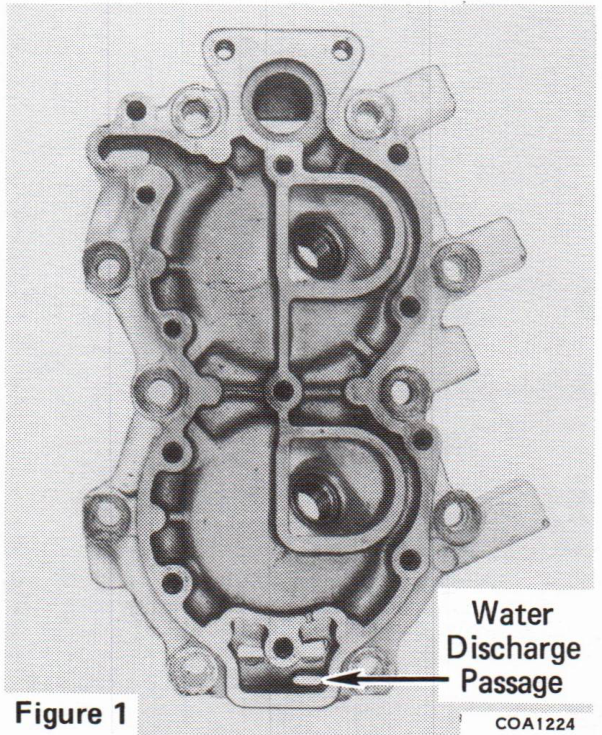
If this cause of an overheating problem is suspected, remove the cylinder head cover to expose the water passages in the cylinder head. The flashing is in the water discharge passage at the bottom of the cylinder head. See Figure 1. Check the other passages for flashing while they are exposed.
Note If the cylinder head shows signs of overheating (discolored paint), it must be removed so that it can be checked for warpage and the cylinders inspected for damage.
If flashing is present use a small punch or other suitable tool to clear the passage.
Reassemble the cover to the cylinder head using OMC Gasket Sealing Compound P/N 317201 on a new gasket. Tighten the screws to a torque of 7-9 N·m (60 to 80 in. lbs.).